“I was born in Odessa, but I never valued that fact...”— Leonid Pasternak, Memoirs
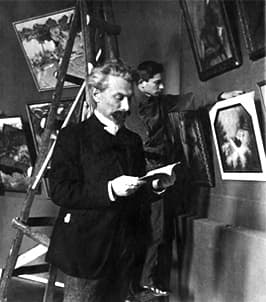
Leonid Pasternak
1862–1945 · Painter & Illustrator
Leonid Osipovich Pasternak was one of Russia's foremost Impressionist painters, renowned for his portraits of Tolstoy, Einstein, Rilke, and other luminaries. A professor at the Moscow School of Painting, Sculpture and Architecture, he illustrated Tolstoy's “Resurrection” and produced an extraordinary body of work spanning oils, pastels, and drawings.
Chronology
- 1862
Born April 4, in Odessa, to Jewish parents. The young Leonid Pasternak develops an early interest in drawing, despite his parents' disapproval.
- 1879
Begins lessons at the Odessa School of Drawing.
- 1881
Enters the medical school of Moscow University, in the hope of also studying at the Moscow School of Painting, Sculpture and Architecture.
- 1882
Still unable to study at the Moscow School of Painting, takes private lessons with the academician Professor E. Sorokin.
- 1883
Abandons medicine for law and transfers to the University at Odessa, which permits him to travel abroad. Attends Munich Academy of Art.
- 1885
Completes law degree and one year of military service in Odessa. Meets Rosalia Kaufmann, the pianist.
- 1888
Paints a large-scale genre painting, A Letter from Home, which is purchased by Pavel Tretyakov for his Moscow gallery. It is exhibited at the Wanderers' exhibition and favourably reviewed.
- 1889
Marries Rosalia Kaufmann; they move to Moscow. Becomes acquainted with the younger painters Valentin Serov and Konstantin Korovin, and others in the circle of Vasilii Polenov, a member of the Wanderers group. Pasternak also meets Ilia Repin, the leading realist painter. Works on the new review, The Artist, and later becomes its art director. Establishes his own drawing school, based on the teaching methods of drawing from life used in Munich and Paris. Visits Paris, where he sees the work of the French Impressionists.
- 1890
Son Boris is born.
- 1892
The North magazine commissions him to illustrate Tolstoy's War and Peace.
- 1893
Meets Tolstoy. Second son, Alexander, is born.
- 1894
Joins the faculty of the Moscow School of Painting, Sculpture and Architecture.
- 1897
Tolstoy invites him to illustrate Resurrection. Exhibits with the World of Art group in St. Petersburg.
- 1900
Visits Paris, where his canvas, Students Before the Examination, is acquired by the Musée du Luxembourg (it now hangs in the Musée d'Orsay). This painting and his drawings for Resurrection are exhibited at the Paris Universal Exhibition. In Moscow, his daughter Josephine is born. Pasternak helps to found the group called the Thirty-Six Artists, forerunner of the Union of Russian Artists.
- 1902
Second daughter, Lydia, is born.
- 1903
Exhibits at the first Union of Russian Artists show, in Moscow.
- 1904
Invited to organize the art section of the international exhibition of art and industry in Düsseldorf. Visits Venice.
- 1905
Elected a member of the Academy of Fine Arts. The abortive Revolution of 1905 closes the Moscow School; with his family he spends several months in Berlin, where he gets to know Lovis Corinth, Max Liebermann, and other German Impressionists.
- 1907
Travels in Holland, Belgium and England.
- 1910
Tolstoy dies. His widow, Sofia Andreyevna, summons Pasternak to make a final, deathbed drawing of him at the railway station of Astapovo, where he died.
- 1912
Visits Germany and Italy.
- 1914
First World War begins. Lithograph, The Wounded Soldier (sales to go to the support of the wounded), is a great popular success.
- 1917
February Revolution; October Bolshevist coup captures the Winter Palace.
- 1918
Civil War in Russia.
- 1921
Moves with his wife and two daughters to Berlin, where he lives and works until 1938. His two sons remain in Moscow.
- 1924
Travels in Egypt and Palestine.
- 1927
First solo exhibition at Galerie Hartberg, Berlin.
- 1932
Second solo exhibition at Galerie Hartberg, accompanied by the publication of a monograph on his work by the art critic Max Osborn.
- 1938
Visits London and prepares for return to Moscow.
- 1939
Death of Rosalia in London. Britain declares war on Germany. Pasternak moves to Oxford to live with his daughter Lydia.
- 1945
Dies in Oxford on May 31, aged 83.
- 1958
The Russian Scene, Pushkin House, London.
- 1958
Memorial Exhibition, Ashmolean Museum, Oxford.
- 1961
Russian Art and Life, Hove Museum, Hove (group exhibition).
- 1962
Centenary Exhibition, City Gallery, Lenbachhaus, Munich. Centenary Exhibition, City Art Gallery and Museum, Bristol. Centenary Exhibition, Herbert Art Gallery and Museum, Coventry.
- 1969
Museum of Private Collections, Moscow. Oxford University Press, Ely House, London. Westfield College, London.
- 1974
Von Maltzahn Gallery, London.
- 1975
Von Maltzahn, representing the London Gallery at the International Arts Fairs at Basel and Dusseldorf.
- 1978
Scottish Arts Council Touring Exhibition shown at: Crawford Centre for the Arts, University of St Andrews; Graves Art Gallery, Sheffield; MacRobert Art Gallery, Stirling; Talbot Rice Art Centre, Edinburgh.
- 1979
Retrospective Exhibition, State Tretyakov Gallery, Moscow.
- 1980
Paris-Moscou (Tolstoy section), Musée National d'Art Moderne, Pompidou Centre, Paris (group exhibition).
- 1982
Leonid Pasternak: 1862-1945, Museum of Modern Art, Oxford.
- 1982
Moskva-Parizh, Pushkin Museum of Fine Arts, Moscow (group exhibition).
- 1984
Ceri Richard Gallery, Taliesin Arts Centre, University College of Swansea.
- 1987
U.S. Tour organized by the Smithsonian Institution Travelling Exhibition Service (Washington DC, New York, Chicago, Palm Beach, Memphis, St. Joseph, Santa Clara, Kansas City).
- 1990
Ashmolean Museum, Oxford.
- 1994
A Musical Offering, Graves Art Gallery, Sheffield.
- 1995
Museum of Private Collections, Pushkin Museum of Fine Art, Moscow (permanent exhibition).
- 1999
Ashmolean Museum, Oxford.
- 1999
The Pasternak Trust: A Family Collection, Oxford (permanent exhibition).