“What is laid down, ordered, factual is never enough to embrace the whole truth.”— Boris Pasternak
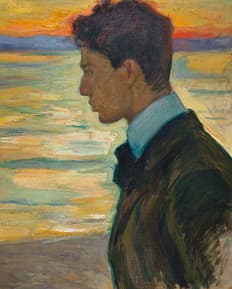
Boris Pasternak
1890–1960 · Poet & Novelist
Boris Leonidovich Pasternak, the eldest son of Leonid Pasternak, became one of the greatest Russian poets of the twentieth century. Awarded the Nobel Prize for Literature in 1958 for his novel “Doctor Zhivago,” he was forced to decline it under Soviet pressure. His lyric poetry, translations of Shakespeare, and prose remain cornerstones of world literature.
Manuscripts
Original manuscripts, letters, and literary documents from the Boris Pasternak archive.
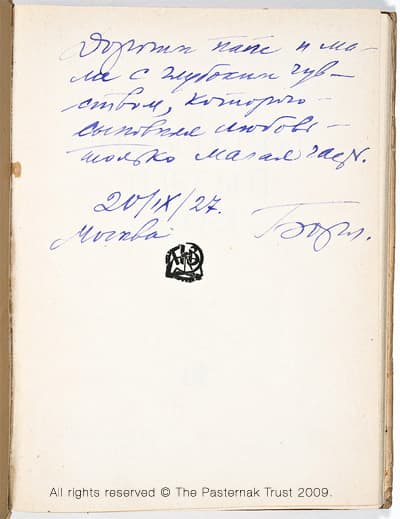
Inscription: ‘For my dear papa and mama with deep feeling, of which filial love is only a small part. 20/IX/27 Moscow Borya’ First edition (1927) of Boris Pasternak, The Year 1905
1927
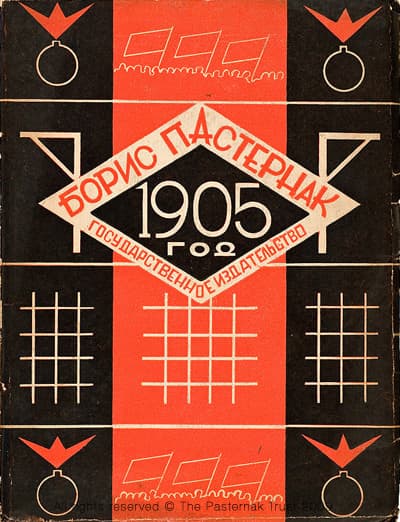
First edition (1927) of Boris Pasternak, The Year 1905
1927
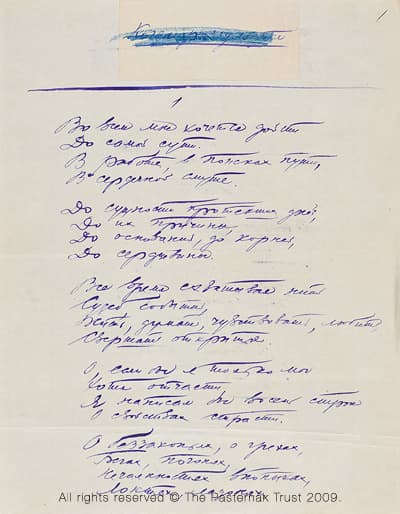
Manuscript of a poem
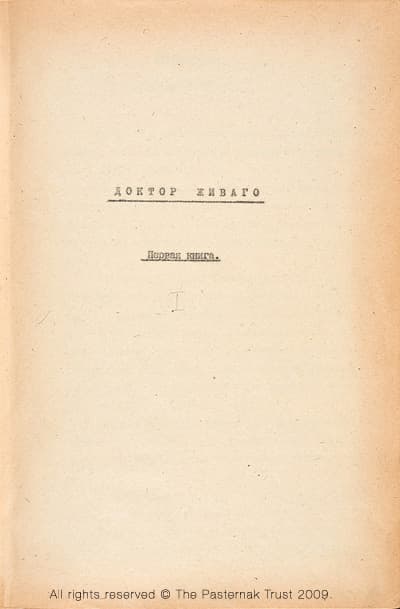
The typescript of Doctor Zhivago Title page
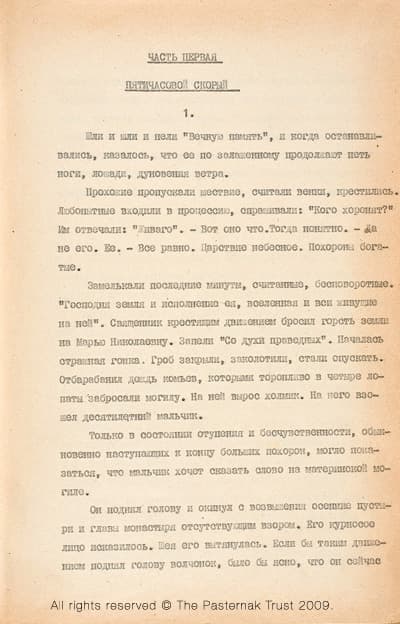
The typescript of Doctor Zhivago First page
Chronology
- 1890
10 February: Boris Pasternak born.
- 1901
August: Boris enters the second class of the Fifth Moscow Gymnasium.
- 1903
Meets the composer A. Scriabin, and begins studying musical composition with the musicologist Yu. Engel.
- 1905
October: teaching in schools and universities interrupted; general political strike. December: Pasternak family leaves for Berlin.
- 1906
July: family visits the island of Rügen; Boris studying with Yu. Engel, composing music (two preludes survive). August: family returns to Moscow.
- 1908
June: Boris completes the Gymnasium with a gold medal. Enrols at the faculty of law at Moscow University.
- 1909
March: meets Scriabin again. May: transfers to the philosophy department of Moscow University. June: completes his Sonata in B minor for pianoforte (also survives).
- 1910
February: first surviving poems and prose writings. November: accompanies his father to Astapovo for Tolstoy's funeral.
- 1912
April: travels to Marburg University, attending philosophy seminars by Cohen, Natorp and Hartmann. August: joins his parents, visiting Italy. Autumn: tutors the son of the industrialist Eduard Salomon.
- 1913
March: submits doctoral thesis on 'Hermann Cohen's theoretical philosophy'. April: the collection Lirika, including five poems by Boris, is published. Graduates with a first-class degree. December: 'Lirika' publishes his first book of poems, Twin in the Clouds.
- 1914
May: meets Vladimir Mayakovsky; tutors the son of the poet Jurgis Baltrušaitis at Petrovskoye.
- 1915
January: working on his tale The Mark of Apelles; tutor in the home of M. Philipp.
- 1916
January-June: travels to the Urals for office work at a chemical factory. October: travels to Tikhie Gory for office work. December: verse collection Over the Barriers published.
- 1917
February: Revolution breaks out in Petrograd. March: Boris returns to Moscow. Composes poems for the collection My Sister Life and starts work on a novel about Zhenia Luvers. October: armed uprising in Moscow.
- 1918
Translates Kleist's plays Prinz Friedrich von Homburg and Die Familie Schroffenstein. July-August: composes the poetry collection Themes and Variations.
- 1919
Translates Goethe's Die Geheimnisse [The Mysteries].
- 1920
Translations from Hans Sachs.
- 1921
Summer: meets the artist Evgenia Lourié. September: Boris's parents and sisters leave for Germany.
- 1922
January: marries Evgenia Lourié. May: the story Luvers' Childhood and verse collection My Sister Life published. August: Boris and his wife join his parents in Berlin.
- 1923
January: verse collection Themes and Variations published. March: returns with his wife to Moscow; September: their son Evgeni born.
- 1924
February: completes the story Aerial Ways, which is published in August.
- 1925
January-March: begins the novel Spektorsky. July: working on the long poem The Year 1905.
- 1926
Spring: starts work on the long poem Lieutenant Schmidt. June-October: his wife and son visit his parents in Berlin.
- 1927
September: The Year 1905 published.
- 1929
January-May: writing A Tale [translated as The Last Summer], published in August. October: Over the Barriers: Poems from various years published.
- 1930
January-April: working on Safe Conduct. 14 April: suicide of Vladimir Mayakovsky. May: permission for Boris to visit Germany refused. September: work completed on Spektorsky. December: Boris leaves his wife and son to live with friends.
- 1931
January: completes Safe Conduct. April: writes verse collection, Second Birth. July: Spektorsky published. July: travels to Tbilisi with Zinaida Neuhaus, later to become his second wife. November: Safe Conduct published.
- 1932
July: travels to Sverdlovsk with Zinaida Neuhaus and her two sons. August: Second Birth published.
- 1933
One-volume edition of his Poems published. November: travels to Georgia with a writers' delegation.
- 1934
January: death of Andrey Bely. May: arrest of Osip Mandelstam; Boris intercedes with Bukharin. June: Boris receives telephone call from Stalin. August: Boris makes a speech at the Writers' Congress. His translation of Vazha-Pshavela's The Snake-Eater published in Tbilisi, Georgia.
- 1935
June-July: Boris is sent to the Anti-Fascist conference in Paris, and visits London. October: his translations of Georgian Lyric Poetry published. N. Punin and L. Gumilyov (son of the poets Nikolay Gumilyov and Anna Akhmatova) are arrested; Boris writes to Stalin and successfully intercedes for them.
- 1936
February: Boris speaks at the Third Plenary Meeting of the Writers' Union, Minsk. Summer: he is allocated a dacha at Peredelkino and writes a verse collection, Summer Notes.
- 1937
Returns to prose (Patrick's Notebook). June: refuses to sign a petition for the execution of 19 army generals. July: suicide of his friend, the Georgian poet Paolo Yashvili. September: arrest of his friend, the Georgian poet Titsian Tabidze. October: arrest of the writer Boris Pilnyak. December: extract of Patrick's Notebook published.
- 1938
January: birth of Boris and Zinaida's son, Leonid. March: Bukharin tried and shot. Boris working on translations of poems by Shakespeare, Verlaine, Alberti, Keats, Byron, and Becher.
- 1939
January-March: translating Hamlet, commissioned by the theatre director Vsevolod Meyerhold. June: Marina Tsvetayeva returns from emigration. Meyerhold arrested in June and his wife, the actress Zinaida Raikh, assassinated in July. August: Boris's mother Rosalia dies in London. Arrest of Tsvetayeva's daughter Ariadna in August, and of her husband Sergei Efron in October.
- 1940
June: publication of Boris's translation of Hamlet, and in October of Selected Translations.
- 1941
March-April: translating Romeo and Juliet and composing the verse collection Peredelkino. June: Nazi Germany invades the Soviet Union. July: Zinaida and her sons evacuated from Moscow; first bombing raids on Moscow. August: Boris sees Tsvetayeva off when she is evacuated and a month later he hears of her suicide. October: Boris is evacuated to Chistopol.
- 1942
February: his translation of Romeo and Juliet completed. September: returns to Moscow and delivers the manuscript of On Early Trains to the printers. December: returns to Chistopol.
- 1943
January-February: translates Antony and Cleopatra. June: On Early Trains published; Boris and Zinaida return to Moscow. August-September: visits the recent battle-fields of Orel with a writers' delegation to the army.
- 1944
Newspaper publication of individual war poems. The translations of Romeo and Juliet and Antony and Cleopatra published. August-September: translates Othello.
- 1945
January: translates Henry IV, Part I. February: the verse collection Earth's Expanse published. April: death of his stepson Adrian Neuhaus. May: Boris's father Leonid dies in Oxford; Othello published. August: translates Henry IV, Part II. November: begins work on Doctor Zhivago. December: Selected Poems published.
- 1946
June: Boris's translations of the Georgian poet N. Baratashvili published. August: decree of Central Committee of the CPSU on the journals 'Zvezda' and 'Leningrad'. September: Fadeyev, Secretary of the Writers' Union, makes a speech criticising Pasternak. First nomination of Pasternak for the Nobel Prize. Boris reads opening chapters of Doctor Zhivago at his dacha at Peredelkino. October: acquaintance with Olga Ivinskaya begins.
- 1947
Reads the opening chapters of Doctor Zhivago at the homes of various friends. July-August: translates King Lear.
- 1948
April: the entire edition of his Selected Works is pulped by the authorities. In the summer, Part I of Doctor Zhivago is typed in several copies which Pasternak sends to friends in Leningrad, Ryazan and Frunze. August-February 1949: translates Faust, Part I.
- 1949
July: two-volume edition of his translations of Shakespeare published. October: Olga Ivinskaya arrested.
- 1950
April: his translation of Goethe's Selected Works published. June: translates Macbeth. December-August 1951: translates Faust, Part II.
- 1952
June: another reading of Doctor Zhivago at his Moscow home. October: hospitalised with myocardial infarction.
- 1953
January: discharged from hospital. March: death of Stalin. May: Olga Ivinskaya released in an amnesty. First draft of Doctor Zhivago completed. Publication of Faust.
- 1954
April: Znamya publishes ten 'Poems of Yuri Zhivago'.
- 1955
March: closing chapters of Doctor Zhivago completed. August-September: translates Schiller's Maria Stuart for Moscow Arts Theatre. October-November: final revision of Doctor Zhivago.